
Abstraction in Focus: High Value Assets Sold at Auction

by Moksha Kumar
Looking to establish an era of Indian art that champions abstraction through myriad approaches, auctions have been a witness to a never ceasing interest of the buyers towards assets that dive boldly into it. Abstraction is no longer an expression but a means to establish a singular visual language that eternally speaks to the masses and offers diverse perspectives. The rendering may be simple or even deeply complex, but the visual plane truly activates in a way that is highly unique to the viewer. Here we explore five assets that breached new heights and showcased a definite pattern of interest and investment through their valuation.
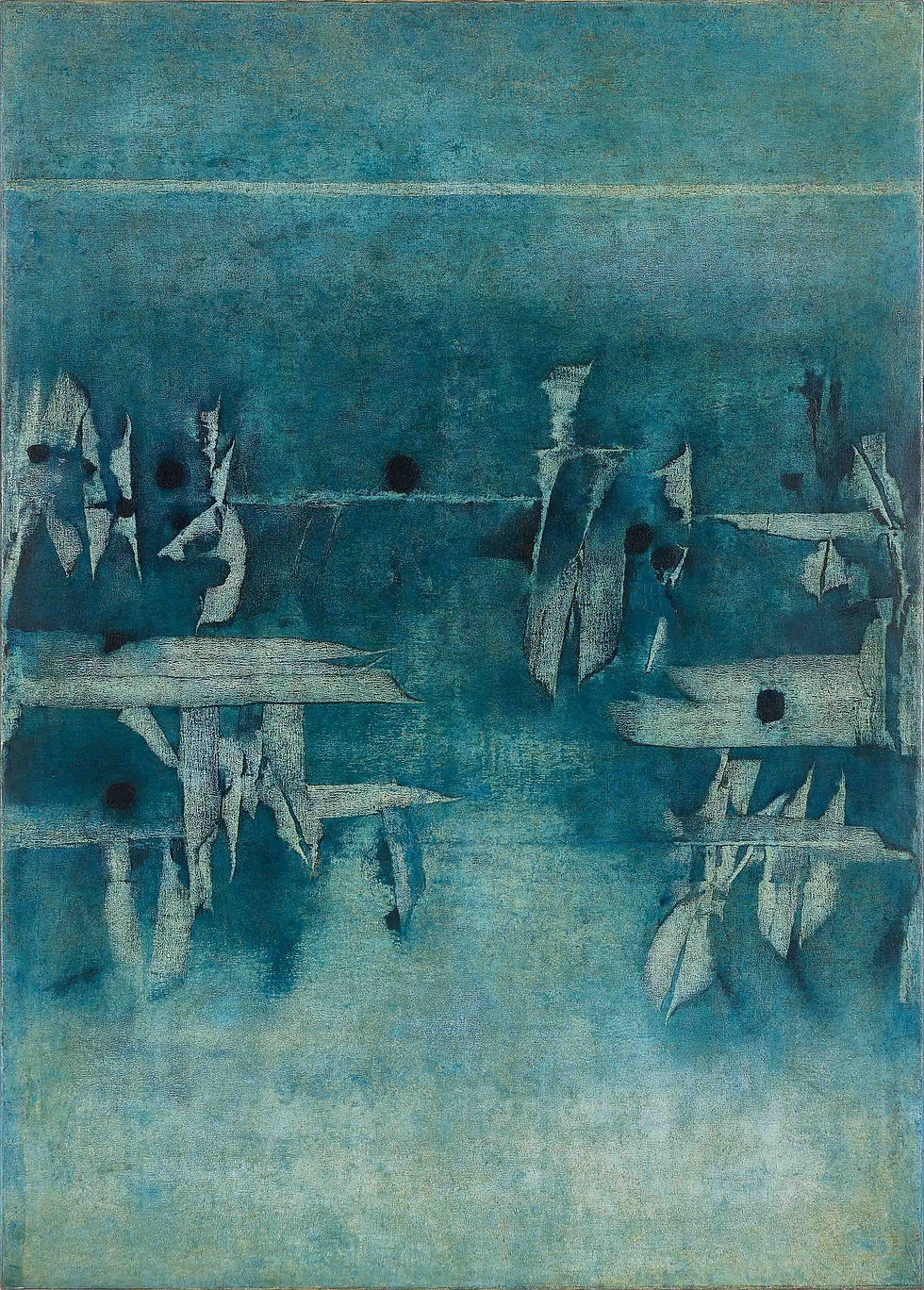
Prior ranked #1 on the Artery India’s Top 500 Artworks list and seeing a sale of a whopping INR 42 Crore at Pundole’s February 2022 auction, V.S. Gaitonde’s 'The Silent Observer' brilliantly finished first, so to speak.
The work here showcases a lasting legacy of Gaitonde’s love for the sea, and his eternal poetic commentary between him and the elements. The deeply textured canvas holds a philosophy as old as time, capturing the innate observations of the artist over time, with absolute ease. The blue washes and strokes of minimal detail captured hearts around the subcontinent, as it broke the artist’s own record for the most expensive sale of an Indian artist’s artwork. The Glenbarra auction on the 24th of February 2022 at Pundole's saw this asset as well as Jagdish Swaminathan’s ‘The Altar’ sell at impressive sums, pushing the narrative of abstraction much further ahead.

“So I paint while I can, though I do not know why I paint. But I do not paint to impart happiness or celebrate the glory of man or the motherland or even to propitiate the dead ...I paint because I cannot keep away from it and because it takes me away from myself. Not knowing what to paint, I start my daily journey in innocence and all the teachings of the masters are of no use to me, for they are mere crutches to one unaware of his own feet.” - Jagdish Swaminathan
Tying back to the recent auction as well as to the rise of abstraction, Jagdish Swaminathan’s ‘The Altar’ comes into focus. The asset was ranked #20 on the Artery India’s Top 500 Artworks list and was valued at INR 22 Crores. The quote above speaks to Swaminathan’s prowess, combining his inner philosophies with the art he envisioned. The depth of his knowledge reverberates as it creates a modified triptych for the viewer to explore. The tempered and informed palette automatically appeals to the viewer, as do the geometric incisions and divisions.
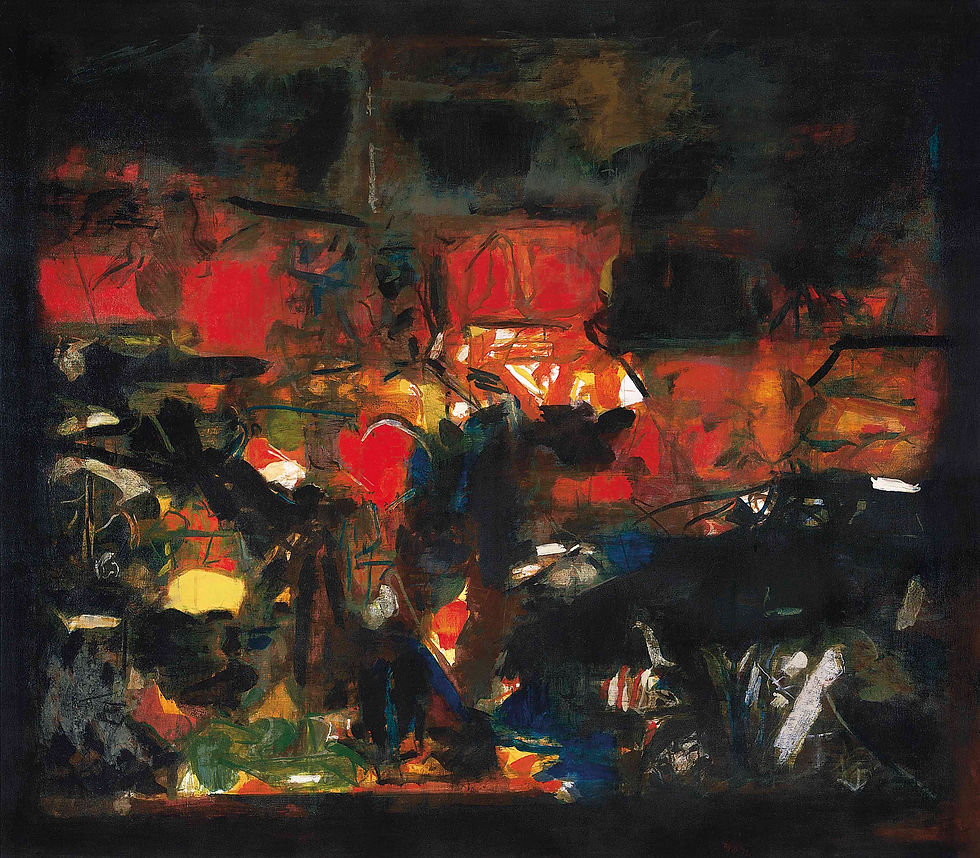
Known to have broken the 2018 world record as S.H. Raza’s most expensive work, the asset ‘Tapovan’ sold for INR 33 Crores at the Christie’s March 2018 auction. The work is a brilliant depiction of abstraction as it veers away from Raza’s early approach and nebulously illustrates his forms. The earth-inspired aspect is strongly present, making the work a wonderful example of singular abstraction from the artist.
Nishad Avari, Christie’s Specialist, commented that ‘’This auction was a landmark sale setting a new category record for Raza’s seminal Tapovan and the highest sale total for the category this season.” The burning embers of crimson red glow divinely as they reverberate against the deep earthy tones and the warmer highlights, offering a fierce energy woven into the abstraction. The tapestry of such a controlled palette allows the depths of knowledge to permeate through the canvas as we see Raza’s intellectual prowess shine through effortlessly. We are drawn to the haphazard geometric incisions that move the eye all over the composition, while holding strongly to the artist’s signature approach.
Prior ranked at #3 on the Artery India Top 50 Artists list, the artist’s practice holds a strong sway over the market, standing tall against the other masters of abstraction and holding his own rather distinctly.
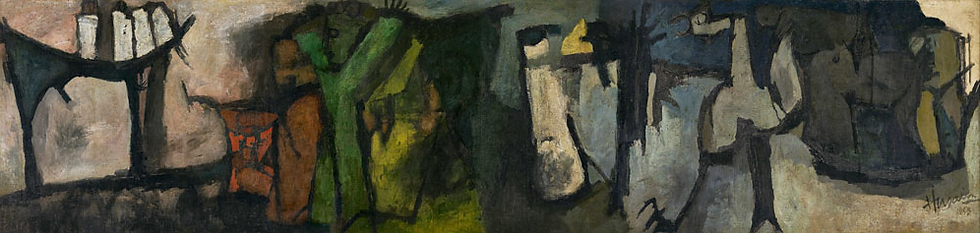
Another brilliant asset that saw a remarkable response was ‘Voices’ by M.F. Husain. It was his most expensive work sold, followed by ‘Battle of Ganga and Jamuna: Mahabharata 12’ and an untitled work from 1956.
“He created this work to proclaim India’s evolving and unified ‘Voice’ as a nation to the world.” - Tushar Sethi, CEO, AstaGuru.
The point remains, that the work is vast and encompasses a wonderful number of references while remaining detached from the literal translation. We are drawn to a more poetic rendition of the geographical as well as the historic context. The image is stunning in the way that it appears, abstracting all the forms on the visual plane.
Holding a large spectrum of tones, the ‘voices’ are imbued in the myriad colours illustrated. It is as though each voice has a specific part to play, encompassing the philosophy of the subcontinent as much as possible. The greys match the vivid tones in the palette and balance the visual plane quite gracefully. Firmly transitioning between forms and shapes, the dramatic overtures and strong brushstrokes showcase the rich visual language that Hussain employed and developed over the years to elucidate the most intriguing of concepts. Deep contrasts of black and cream allow our gaze to pass over from one extreme of the canvas to the other, but still come back to the vibrant tones as a break to such intensity.
Streams of consciousness ebb and flow, as we see the jeweled tones weave in and out of the forms, playfully igniting our imaginations. As our gaze traverses the canvas, we are drawn to its many parts simultaneously.

“My art, a mixture of academic, impressionist and cubist texture, form and colour, acquired a distinct style in the mid ’60s. And with each step I have evolved a new experience. But if I look back, I find I have carried all the elements forward.” - Jehangir Sabavala, Saffronart
‘The Embarkation’ is a beautiful example of the above quote, where the image does due justice to the artist’s definitive period of production during the 1960’s. Auctioned at Christie’s September 2021 sale, the lot sold for five times its low estimate, at 1.59 million dollars or INR 12.3 Cr. Establishing a new record, Sabavala’s work saw a renewed interest through young collectors and buyers. The artist holds ₹19 Crores in record sales, till date.
The statistics are an interesting marker of the artist’s gradual progress into the limelight, as his work sees a new high in the current contemporary context. The artwork in question was made in 1965, in the era where the artist purified and clarified his visual language, manifesting paintings that would then become sites of epiphany. “Through Feininger’s pure, precise and yet very delicate and personal renderings of cloud and boat and sea, I discovered the joys of extending form into the beauty and clarity of light. I became interested in the source of light, its direction, its effect. Through these experiments, gradually, my work changed.” - Jehangir Sabavala, Sotheby’s
While abstraction is seeing a steady rise, it is no stranger to Indian aesthetics as a marker of a massive amalgamation of concept, philosophy and worldly perspective. Knowing the vast extent of India’s history and cultural significance, the artists truly embody the expansive and generously vibrant spirit of the subcontinent, both in diverse and distinguished brilliance.
